
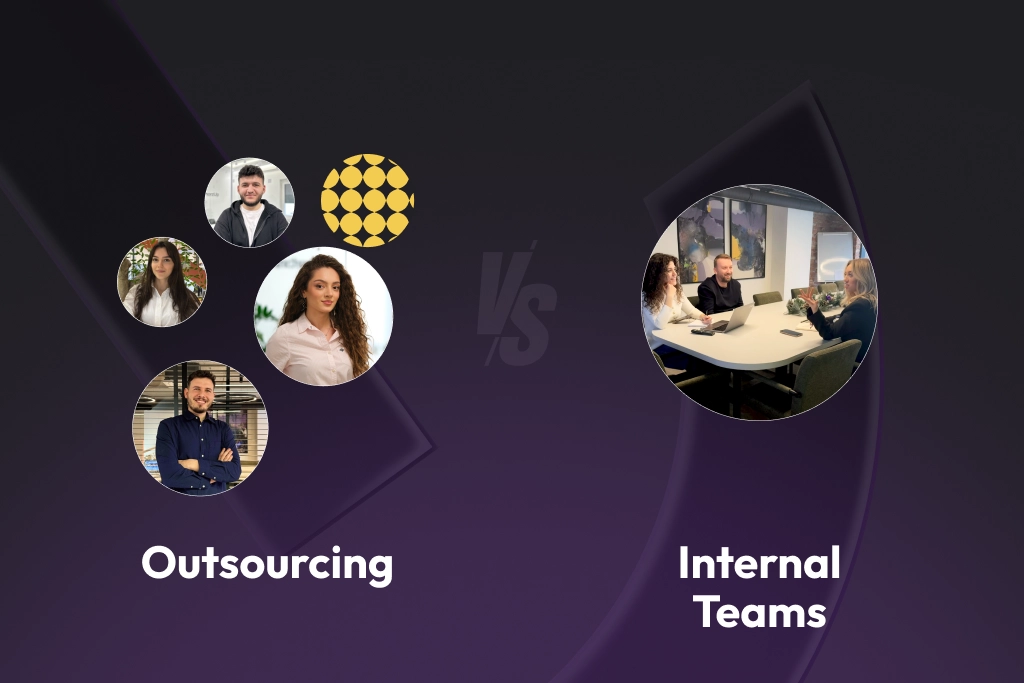
Swiss companies face a critical choice when expanding teams or launching new projects: should they hire internally, or leverage outsourcing to access specialized talent and accelerate growth? In high-demand areas like software development, product design, and digital marketing, this decision comes down to cost, speed, and risk. Making the right choice can mean faster project delivery, controlled expenses, and access to expertise that might be scarce locally.
The cost factor: How expensive is Swiss labor
Hiring internally in Switzerland is expensive. Software developers, for example, earn around CHF 103,000 per year on average, with senior roles commanding even higher salaries, before employer contributions and benefits are included (swissdevjobs.ch). Product designers and digital marketers carry similar costs.
Outsourcing, particularly to regions like Kosovo, can reduce operational costs by 30-50% while maintaining quality. Companies pay per project or on a retainer, giving predictable expenses and flexibility.
What should Swiss companies consider when outsourcing instead of hiring internally?
Outsourcing offers Swiss companies immediate access to skilled teams, faster project delivery, and scalable resources, making it an efficient way to achieve business goals without the overhead of hiring internally. (itconcepts.ch)
However, companies should be mindful of potential challenges, such as quality control, data security, and compliance. Partnering with an experienced provider like AnchorzUp mitigates these risks through established processes, rigorous quality assurance, and secure workflows. Compared to in-house teams, outsourcing also allows companies to flexibly scale resources up or down based on project needs, ensuring efficiency without leaving internal employees underutilized.
How Can Companies Scale Teams Quickly Without Sacrificing Quality?
Time is a crucial factor when scaling teams without compromising quality. Recruiting internal talent for senior roles often takes 2–4 months, including posting vacancies, interviewing candidates, and onboarding (lhh.com). To address this challenge, we have built a streamlined recruitment process that allows us to assemble qualified teams in 3-8 weeks.
This speed, combined with outsourcing, gives companies immediate access to specialized expertise in software development, product design, and digital marketing. Instead of committing to long hiring cycles, businesses can scale teams based on actual project needs, whether launching a digital campaign or developing a new software module, ensuring the right level of resources without leaving internal capacity underutilized.
For example, a Swiss client we partnered with initially outsourced digital marketing and branding. The collaboration has now expanded to a dedicated team covering social media, product design, UI/UX, and more. Because our teams are geographically close and in compatible time zones, the client can easily communicate in real-time, plan together, and even visit our office to meet the team in person. This approach has accelerated projects, controlled costs, and provided access to specialized skills while maintaining internal strategic oversight.
When Should Swiss Companies Use a Hybrid Model?
Not every function should be fully outsourced. Many Swiss companies adopt a hybrid approach, keeping a small in-house core team for strategic oversight while outsourcing execution to specialists. This model provides the best balance of control, cost efficiency, and access to expertise, allowing companies to scale effectively without overburdening internal teams.
Conclusion
For Swiss companies, the choice between in-house hiring and outsourcing is no longer just about cost. Outsourcing offers faster delivery, lower operational risk, and access to specialized talent, particularly in software development, product design, and digital marketing.
Swiss companies looking to scale efficiently and minimize risk should consider outsourcing with reliable nearshore partners. Teams ready to deliver from day one mean projects move faster, costs are controlled, and results are measurable.